
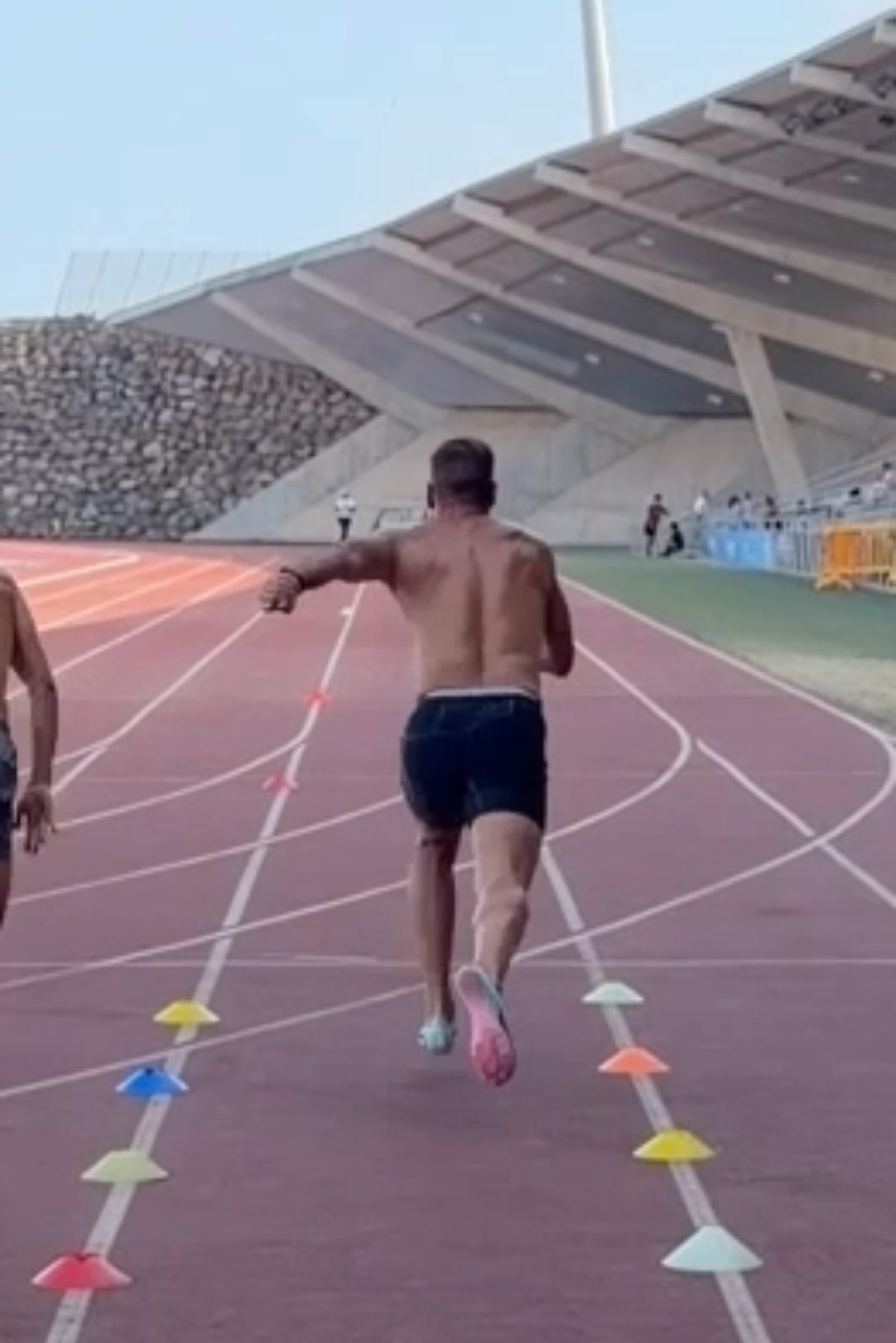
Every sprint, measured like a lab would.
One LiDAR sensor and your phone. Every run ends up on video with the speed burned in and the force-velocity profile straight away. No timing gates, no operator.
How it works
-
1
Place it
Set the sensor behind the start or at the end of the straight, pointing at the athlete along their running line. No cables, no calibration: it is measuring in seconds.
-
2
Arm it
The app spots the athlete starting and records on its own, with pre-roll: the block start is never lost.
-
3
Run
Video, data and analysis are saved straight away. The system re-arms for the next athlete.
Everything a speed coach needs
One device replaces the timing gates, the radar and the camera. And adds the analysis that used to need a lab.
-
Automatic capture, hands free
Motion trigger with real pre-roll and automatic re-arming. Athlete after athlete, without touching the phone.
-
Video with the data burned in
Instantaneous speed and acceleration, a stopwatch to hundredths and a chart with a playhead, burned into the video. With a trim editor and your club’s watermark.
-
Professional sprint analysis
Force-velocity profile (V₀, F₀, Pmax) from a single run, splits from 5 to 40 m and a stride estimate.
-
Ready for the coach
A PDF report with your branding, Excel and JSON export, a library you can read without the sensor, and cloud sync.
Samozino / Morin model
The whole force-velocity profile, from a single run
A single 40 m run is enough. The speed curve gives up all five parameters, and three of them are the same construction.
- V₀
- 9.42m/s
- top speed
- τ
- 1.18s
- time constant
- a₀
- 8.0m/s²
- initial acceleration
- F₀
- 612N
- initial force
- Pmax
- 1,441W
- peak power
Sample values from a real run measured with the prototype.
- Automatic splits from 5 to 40 m, and speed and acceleration curves against time and against distance, with the model overlaid.
- Step estimation (experimental): cadence, stride length and the braking-propulsion split, always with its confidence indicator.
- Serious processing: a Kalman filter plus RTS smoothing, automatic detection of the start instant, and plausibility warnings.
Against what you already know
-
vs. timing gates
A continuous profile of the whole run, not just splits. Synchronised video, set up in seconds, and one device in the bag.
-
vs. sports radar
A fraction of the price and the size, with overlaid video, built-in analysis and exports ready for the coach.
-
vs. video apps
Real data from a 180 m sensor at 100 Hz, not computer-vision estimates that break with the light or the framing.
Where the development stands
We would rather say it plainly: the prototype works and we use it daily, but there are things left to validate.
What works today
- Automatic capture with real pre-roll, tested on physical hardware: video + data without touching the phone.
- Video with a speed and acceleration overlay, a trim editor, and export to PDF, Excel and JSON.
- Force-velocity profile analysis (V₀, F₀, Pmax) and splits, from real sensor data at 100 Hz.
- A battery reading real hours of use remaining (a dedicated fuel gauge), and sensor firmware updates over Bluetooth from the app itself.
What we are still working on
- Estimating the number of ground contacts and the stride length is experimental: it carries a confidence indicator and still fails on noisy readings.
- Validation against timing gates and field testing with athletes are under way: which is why we are asking coaches for feedback.
- The hardware is a prototype: there is no release date and no final price.
- Sample rates above 100 Hz: the hardware goes up to 1000 Hz, but we have not tested that on the track yet.
Would you want a Banot on your track? Tell us.
We are building Banot with coaches. Leave us your email: we will ask what you make of what we are building and tell you how it is going, without hype and without spam.
Would you rather write to us directly? drimiun@drimiun.com